
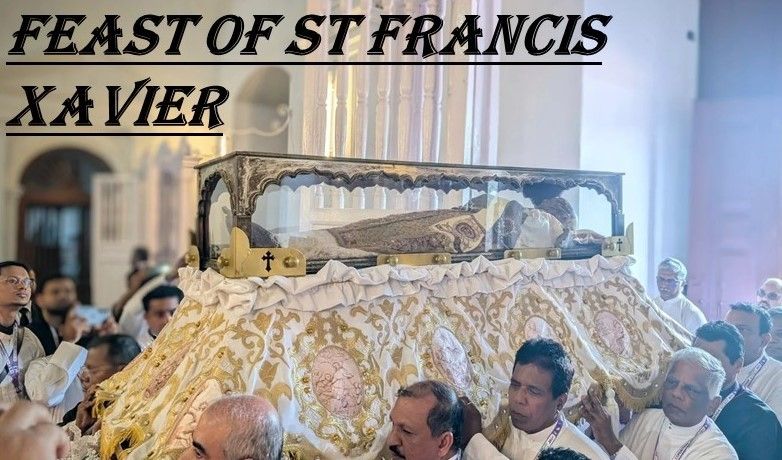
The Feast of St. Francis Xavier is one of the most revered religious and cultural events in Goa, celebrated annually on December 3rd at the Basilica of Bom Jesus in Old Goa. This day marks the death and burial of St. Francis Xavier, the legendary Catholic missionary whose body lies in a silver casket inside the church. Affectionately called Gencho Sahib or “Lord of Goa,” he is honored by Goans and pilgrims from across the globe through solemn prayers, vibrant ceremonies, and festivities that seamlessly blend spirituality with community joy.
The Festive Spirit in Goa
The feast is not confined to a single day but extends over nine days of novenas, attracting thousands of devotees. Church services begin as early as 4 a.m., with masses conducted in multiple languages to accommodate the diverse gathering. The streets of Old Goa transform into a lively fairground, lined with stalls selling food, trinkets, and souvenirs. Traditional Goan delicacies and festive drinks add flavor to the celebration, while cultural programs, fairs, and music create a dynamic atmosphere.
For Goans, the feast is more than a religious observance it is A Time For Families to Reunite, communities to bond, and tourists to immerse themselves in the unique blend of devotion and festivity that defines Goa.
Early Life and Missionary Work
St. Francis Xavier was born in Spain on April 7, 1506. He arrived in Goa in 1543with the Portuguese Viceroy, dedicating his life to spreading the Gospel and educating the people. Despite language barriers, he worked with Goan scholars to translate prayers and teachings, enabling mass conversions across villages. His missionary zeal carried him far beyond India:
- In 1545, he traveled to the Spice Islands.
- By 1549, he reached Japan, where he successfully converted hundreds to Christianity.
- Later, he attempted to enter China, but his journey ended tragically when he died of fever on December 2, 1552, on Sancian Island near the Chinese mainland.
The Legend of the Incorrupt Body
One of the most remarkable aspects of St. Francis Xavier’s legacy is the legend of his incorrupt body. When his remains were exhumed months after burial, they were found miraculously preserved. A Jesuit brother even reported blood oozing from a severed finger. This extraordinary occurrence was acknowledged by the Vatican, which canonized him as a saint.
His body was eventually brought to Goa and enshrined in the Basilica of Bom Jesus. Over centuries, expositions of his remains drew massive crowds, though the last public exposition was held in 1994due to visible deterioration.
Relics and Healing Power
Pieces of St. Xavier’s hand were distributed worldwide under papal orders, believed to possess healing powers. Pilgrims continue to venerate these relics, seeking blessings and miracles. The Basilica remains a sacred site where faith, history, and devotion converge, making it a focal point of Christian spirituality in Asia.
Cultural and Spiritual Significance
The Feast of St. Francis Xavier is more than a religious festival it is a fusion of faith, tradition, and community spirit. It reflects Goa’s unique cultural identity, shaped by Portuguese Influence and Catholic Devotion, yet celebrated with the warmth and hospitality of Goan society.
The event underscores the enduring legacy of St. Francis Xavier, whose missionary zeal and compassion left an indelible mark on Asia. His feast continues to inspire devotion, unity, and joy among Goans and visitors alike, making it one of the most vibrant celebrations in India’s cultural calendar.