
Introduction
Ala-ud-din Khilji, born Ali Gurshasp, remains one of the most formidable figures in the history of medieval India. Rising to power in 1296 CE after the assassination of his uncle and father-in-law, Jalal-ud-din Khilji, Ala-ud-din ruled the Delhi Sultanate until 1316 CE. His reign marked a decisive turning point, defined by military brilliance, sweeping administrative reforms, and a remarkable ability to repel repeated Mongol invasions. Though ruthless in consolidating authority, he is remembered as a visionary monarch who reshaped the socio-political and economic foundations of the Sultanate.
Expansion of the Khilji Empire
Under Ala-ud-din’s leadership, the Delhi Sultanate reached its greatest territorial extent. His dominion stretched from the Himalayas in the north to the Deccan plateau in the south, and from Gujarat in the west to Bengal in the east. Rajput strongholds were subdued, Gujarat and Malwa annexed, and his trusted general Malik Kafur spearheaded campaigns deep into the Deccan. These expeditions brought Devagiri, Warangal, Dwarasamudra, and Madurai under the Sultanate’s influence. The vastness of the empire was matched by its administrative efficiency, ensuring prosperity and stability across diverse regions.
The Nature of His Rule
Ala-ud-din’s reign lasted two decades, during which he consolidated authority with an iron hand. His governance was marked by strict discipline, centralization of power, and suppression of rebellions. Merciless toward opponents yet pragmatic in administration, he combined severity with foresight. His rule is remembered not only for territorial conquests but also for reforms that transformed the economic and social structures of medieval India. By curbing the influence of nobles and strengthening central authority, he ensured resilience against both internal dissent and external threats.
Political and Social Policies
Determined to prevent conspiracies and maintain loyalty, Ala-ud-din introduced policies that curtailed the privileges of nobles. He abolished the practice of granting land to aristocrats, restricted their social gatherings, and prohibited marriages without state approval. These measures reduced the chances of rebellion and reinforced the Sultan’s supremacy. His policies reflected a keen understanding of the political dynamics of the time, ensuring that the Sultanate remained unified under his command.
Economic Reforms
Ala-ud-din’s economic policies were revolutionary for their time. He introduced market regulations to stabilize the prices of essential commodities such as grain, cloth, and horses. State granaries were established, and trade was closely monitored by appointed officials. Merchants were required to register, and violations were met with severe punishments. These reforms ensured affordable supplies for both the army and the general population. By controlling inflation and securing resources, Ala-ud-din strengthened the economic foundation of the Sultanate while maintaining military readiness.
Revenue System
The Sultan reorganized the revenue system to maximize state control over agrarian resources. Land revenue was collected directly from peasants, fixed at 50% of the produce—a heavy burden but one that filled the treasury. Detailed land surveys were conducted to assess productivity, and revenue officials were appointed to minimize corruption. This system reduced the power of intermediaries and enhanced the Sultan’s authority over rural economies. Though harsh, it provided the financial backbone for his ambitious military and administrative programs.
Military Administration
Ala-ud-din maintained one of the strongest standing armies of his era. To ensure discipline and prevent corruption, he introduced reforms such as branding horses (dagh) and maintaining descriptive rolls of soldiers (chehra). Soldiers were paid in cash rather than land grants, ensuring their loyalty to the Sultan rather than to local landlords. These measures created a professional and efficient military force, capable of defending the empire and expanding its frontiers. His military administration became a model of centralized control and organization.
Mongol Threat and Resistance
The Mongols posed a formidable challenge to the Delhi Sultanate, launching repeated invasions between 1297 and 1308. Ala-ud-din’s military genius enabled him to repel these attacks successfully. His victory at the Battle of Jaran-Manjur in 1297 and subsequent campaigns safeguarded Delhi from foreign domination. Few rulers in Asia managed to resist the Mongols as effectively as Ala-ud-din, and his success in defending India against their incursions remains one of his most enduring achievements.
Conquests and Wealth
Ala-ud-din’s conquests were extensive and lucrative. Gujarat fell in 1299, Ranthambore in 1301, and Malwa in 1305. Malik Kafur’s southern campaigns brought immense wealth to the Sultanate, including the famed Koh-i-Noor diamond. These victories not only expanded the empire but also demonstrated the military superiority of the Khilji dynasty. The influx of wealth from these campaigns strengthened the Sultanate’s economy and funded further reforms, cementing Ala-ud-din’s reputation as both a conqueror and administrator.
Tomb and Architectural Legacy
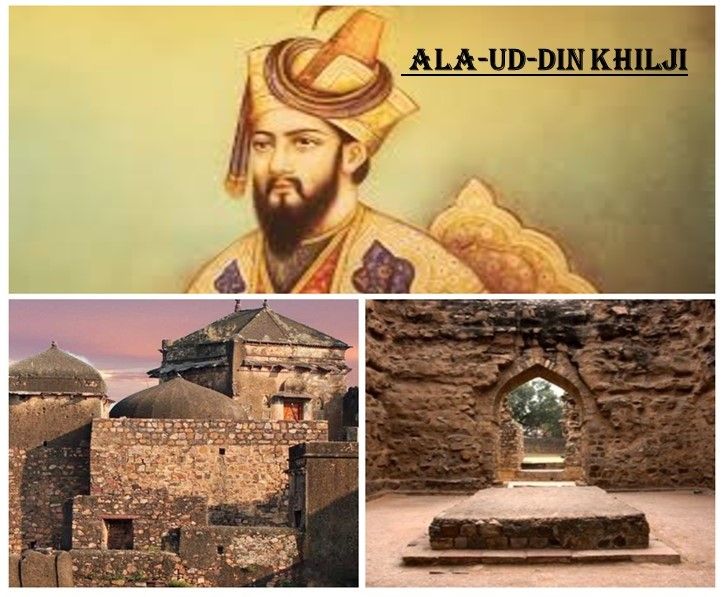
Ala-ud-din Khilji died in 1316 and was buried near the Qutb Minar complex in Delhi. His tomb, adjacent to the madrasa he established, is modest compared to other royal mausoleums. Built of rubble masonry, it is square in plan with arched entrances and a dome, reflecting the architectural style of the period. The adjoining madrasa was among the earliest Islamic educational institutions in India, symbolizing his commitment to learning and culture. The simplicity of the tomb contrasts with the grandeur of his reign, offering insight into the architectural trends of the Khilji era.
Madrasa-Tomb Complex
The madrasa-tomb complex of Ala-ud-din Khilji represents a fusion of religious and educational functions. The madrasa served as a center of Islamic scholarship, while the tomb commemorated the Sultan’s legacy. This combination became a model for later rulers, blending spirituality, education, and remembrance. It highlights Ala-ud-din’s cultural contributions beyond his Military and Administrative achievements, underscoring his role in shaping the intellectual landscape of medieval India.
Conclusion
Ala-ud-din Khilji was more than a conqueror; he was a visionary ruler whose reforms left a lasting imprint on Indian history. His reign strengthened the Delhi Sultanate, expanded its boundaries, and introduced policies that influenced society for centuries. His resistance against the Mongols preserved India’s independence from foreign domination, while his economic and military measures ensured stability and prosperity. Though his tomb is modest, his legacy endures as one of the greatest rulers of medieval India an empire-builder, reformer, and defender of the realm.